Three Ways to Integrate an AI Customer Service Chatbot into WeCom for the Chinese Market
June 11th, 2026 · Written by Samuel Jesse

Contents
WeChat Ecosystem Has Become a National-Scale Digital Infrastructure
According to Tencent's 2025 annual financial report released in March 2026, the combined MAU (Monthly Active User) of WeChat and Weixin had reached 1.418 billion. In China, this effectively means that nearly every individual with mobile internet access uses WeChat. Meanwhile, WeChat Mini Programs have also reached 946 million monthly active users. Today, WeChat has evolved far beyond a messaging app. It is now deeply integrated into daily life and business operations across China, functioning as a core piece of digital infrastructure.
As customer acquisition costs continue to rise across public traffic platforms, more businesses are shifting toward private-domain strategies. WeCom has naturally become the preferred platform for this transition, thanks to its enterprise-verified identities, low-cost one-on-one communication model, and seamless integration with Channels, Official Accounts, and Moments.
However, the rapid growth of private-domain users has exposed the limitations of traditional customer service models. WeChat users expect conversational, real-time responses, and delays of even a few minutes can significantly reduce engagement and conversion rates. Since customers remain active around the clock, especially during nights and holidays, relying solely on human agents is no longer sustainable. As a result, deploying efficient and intelligent AI customer service chatbots has become an increasingly essential strategy for brands.
Three Main Approaches for Integrating AI Customer Service into WeCom
At present, there are three mainstream approaches for Chinese enterprises to integrate AI customer service chatbots into the WeCom ecosystem, and each corresponds to different levels of technical depth and operational autonomy.
Approach One: Native Official Integration (The "Out-of-the-Box" Way)
This is a native feature provided directly by WeCom. Enterprises do not need any development capabilities. They simply enable the "WeChat Customer Service" feature in the WeCom admin console. Brand administrators can directly input Q&A pairs or upload business documents in the backend. After configuring the chatbot, it can automatically answer common customer inquiries such as after-sales policies, return and exchange policies, product manuals, and tutorial videos.
However, this approach also comes with significant limitations. In essence, it functions as a form of "search-based AI." It behaves more like an intelligent indexing system that searches the predefined knowledge base for the most relevant answer whenever a user asks a question. As a result, it cannot understand complex conversational context, nor can it integrate with enterprise membership systems or order management systems. It can "talk," but it cannot "act."
This approach is suitable for handling highly standardized FAQs and scenarios with simple business logic that only require basic customer support inquiries.
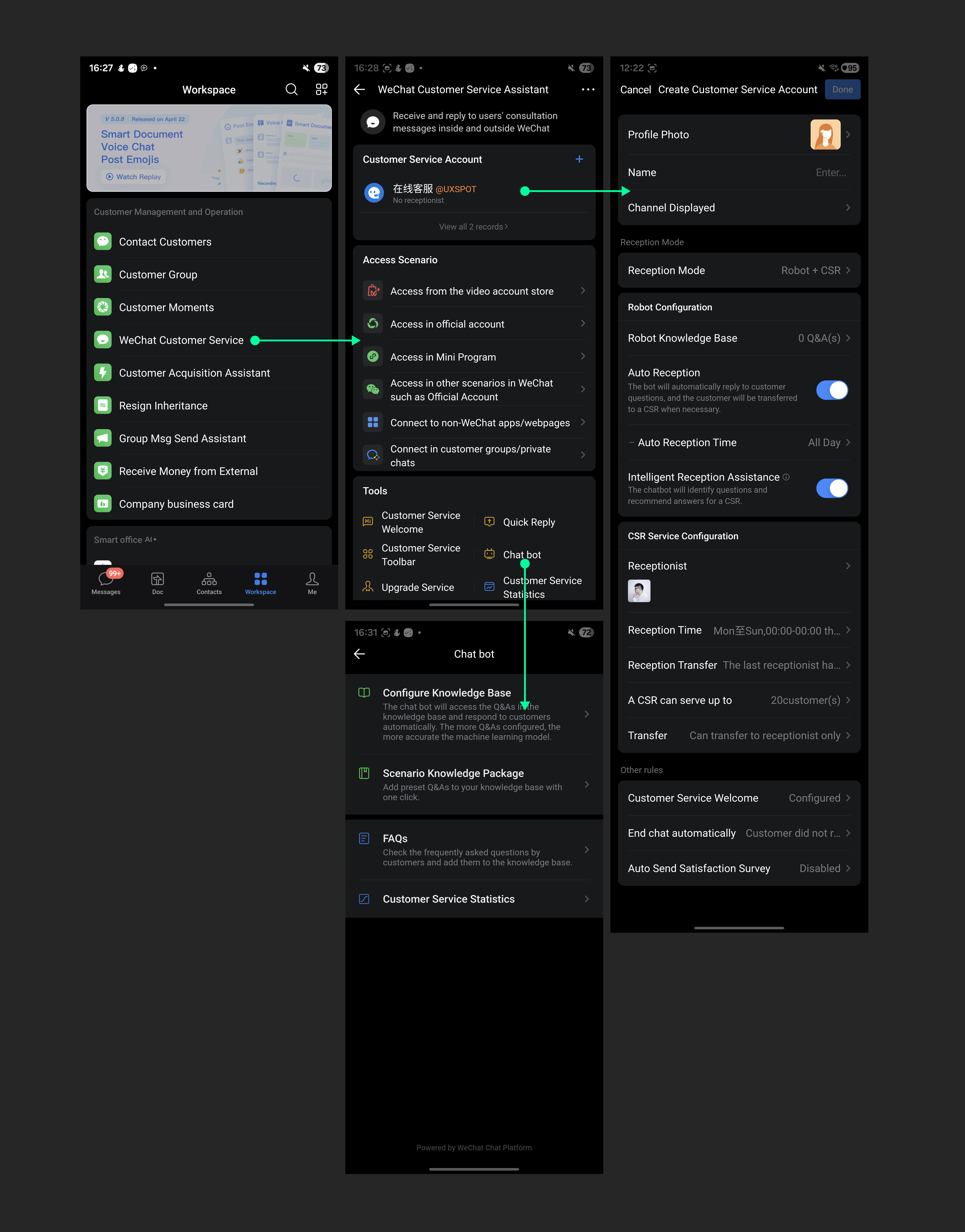
Approach Two: SCRM Integration via Third-Party Authorization (The "Customized" Way)
The native functionality provided by WeCom is limited and cannot satisfy the needs of enterprises with more advanced requirements. As a result, many companies choose to purchase third-party SaaS platforms. These SaaS products are typically SCRM systems or specialized customer service platforms. SCRM platforms often integrate features such as AI chat assistants, response recommendations, customer tagging, and conversation analytics. Dedicated customer service SaaS platforms are more specifically designed for support operations and can integrate not only with ticketing systems, but also with CRM platforms and other enterprise systems.
For business owners who want to deploy an AI customer service chatbot on WeCom using a third-party SaaS platform, the entire process generally requires no complex technical operations and mainly involves authorization-based setup.
- First, prepare a verified WeCom account with administrator privileges and enable the WeChat Customer Service feature. Then select a suitable third-party customer service SaaS platform and purchase the appropriate subscription plan.
-
- Next, log into the SaaS backend, create an AI chatbot independently, upload common business information such as product introductions into the knowledge base, and configure basic rules including automated greetings and human agent escalation.
- Then, log into the WeCom admin console as an administrator to obtain key credentials such as the Enterprise ID and application secret. Complete the authorization and account binding process within the SaaS platform. After the integration is completed, configure the message push interface in the WeCom customer service backend so that customer inquiries can be automatically forwarded to the third-party AI system.
- Once these steps are completed, the enterprise can distribute its WeCom customer service QR codes externally. Whenever customers scan the code and send messages, the AI chatbot can automatically receive and respond to inquiries in real time, enabling 24/7 intelligent customer service operations.
This approach requires no development, is ready to use out of the box, remains compliant and stable, and offers strong data security guarantees. It also enables enterprises to unlock many additional capabilities. In terms of effectiveness, it is naturally superior to the first approach, delivering more professional, comprehensive, and human-like responses. However, flexibility is ultimately constrained by the vendor. Businesses can only use the features that the provider has already developed. If a company has unique workflows, such as cross-app data synchronization, it often encounters the "data silo" problem, where systems cannot be fully interconnected.
Approach Three: API-Based Self-Built Deep Integration (The "Tech-Savvy" Way)
If you want the chatbot not only to converse, but also to understand business workflows like an experienced employee, conduct professional brand-level conversations, and fully integrate with all internal company data, if your team possesses in-house development capabilities and requires greater control over data and scalability, then an API-based self-built integration will be the most flexible and suitable solution.
Through WeCom's official Open APIs, enterprises can directly connect chatbots to their own business backend systems. Since 2023, with the rapid advancement of large language model technologies, this approach has unlocked tremendous commercial value. By integrating models such as DeepSeek, Llama, or privately deployed enterprise LLMs, combined with RAG (Retrieval-Augmented Generation) technology, AI chatbots have begun to demonstrate logically rigorous, empathetic, and human-like conversational abilities. All conversation histories and user preference data remain entirely within the enterprise's private servers, making the solution both secure and highly valuable for future analysis.
Its implementation logic mainly consists of three core steps:
- First, continuously monitor incoming messages received through WeCom. To achieve this, enterprises must preconfigure a message receiving server URL in the WeCom admin console. Whenever a customer sends a message, the WeCom server immediately sends an encrypted request to that address.
- Next, the enterprise server receives and decrypts the request, extracts the customer's original intent, and forwards the information to the integrated large language model, such as DeepSeek, Llama, or a self-hosted enterprise model. Guided by the enterprise's instruction set, along with model inference and retrieval-augmented techniques, the AI generates accurate and highly natural responses.
- Finally, the enterprise backend service calls WeCom's official "Send Application Message" API to instantly push the AI-generated reply back to the client. From the moment the user submits a question to the moment they receive an answer, the entire process is typically completed within seconds, ensuring that customer service operations can run smoothly 24/7.
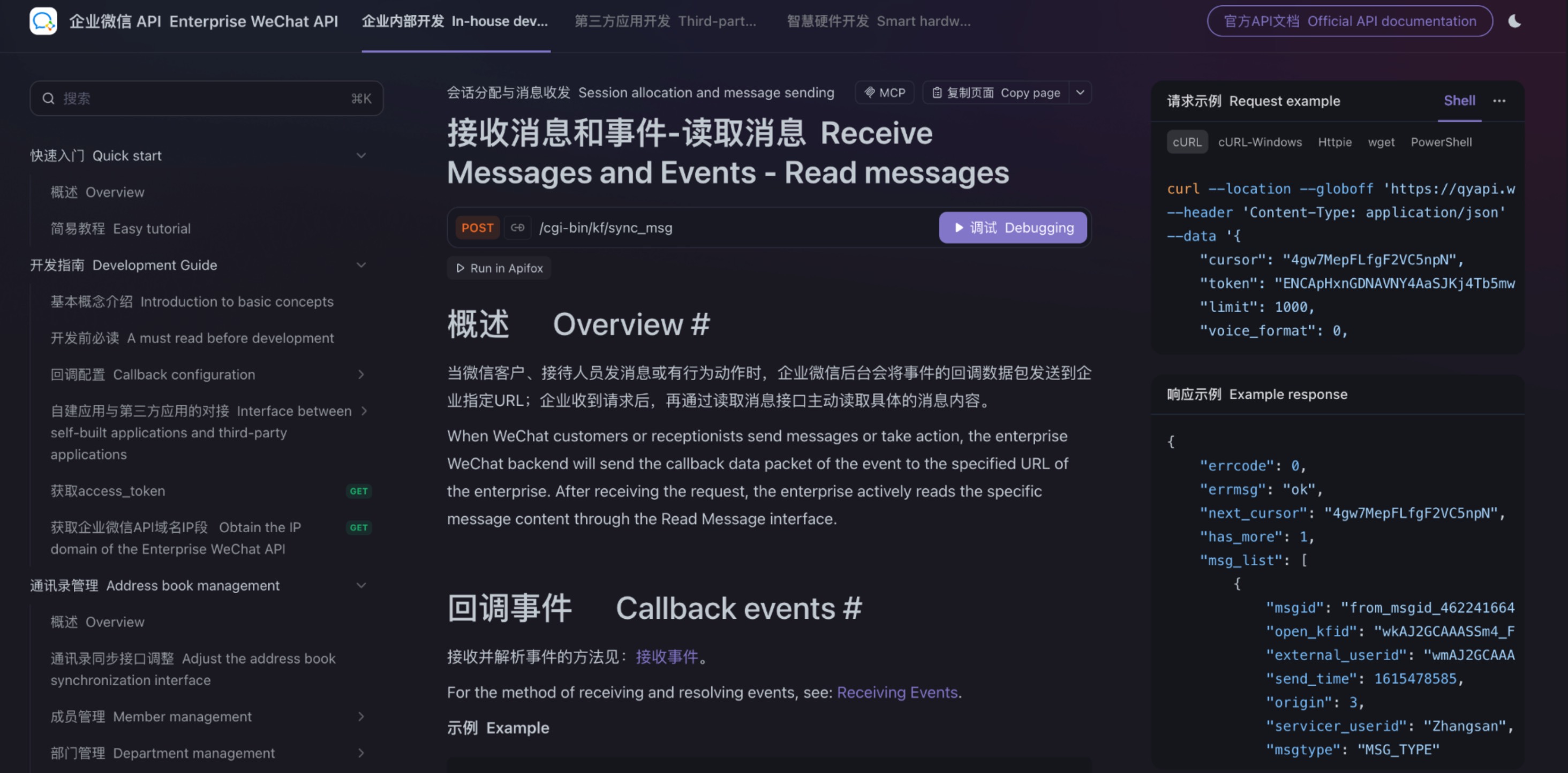
Case Study: How Recap Empowers User Research Through Deep Integration with the WeChat Ecosystem
Above, we introduced three approaches for integrating AI into WeCom and explained their underlying principles. Next, we would like to use Recap as an example to further demonstrate how the WeCom marketing ecosystem and AI can be implemented in real business scenarios.
Recap is a user research solution deeply optimized for the Mainland China digital ecosystem. It covers the entire project lifecycle, from participant recruitment and project execution to analysis, while fully leveraging the benefits brought by the WeCom ecosystem and AI integration. This ecosystem mainly consists of a Mini Program, WeCom accounts, native mobile apps (iOS and Android), and a web-based management platform.
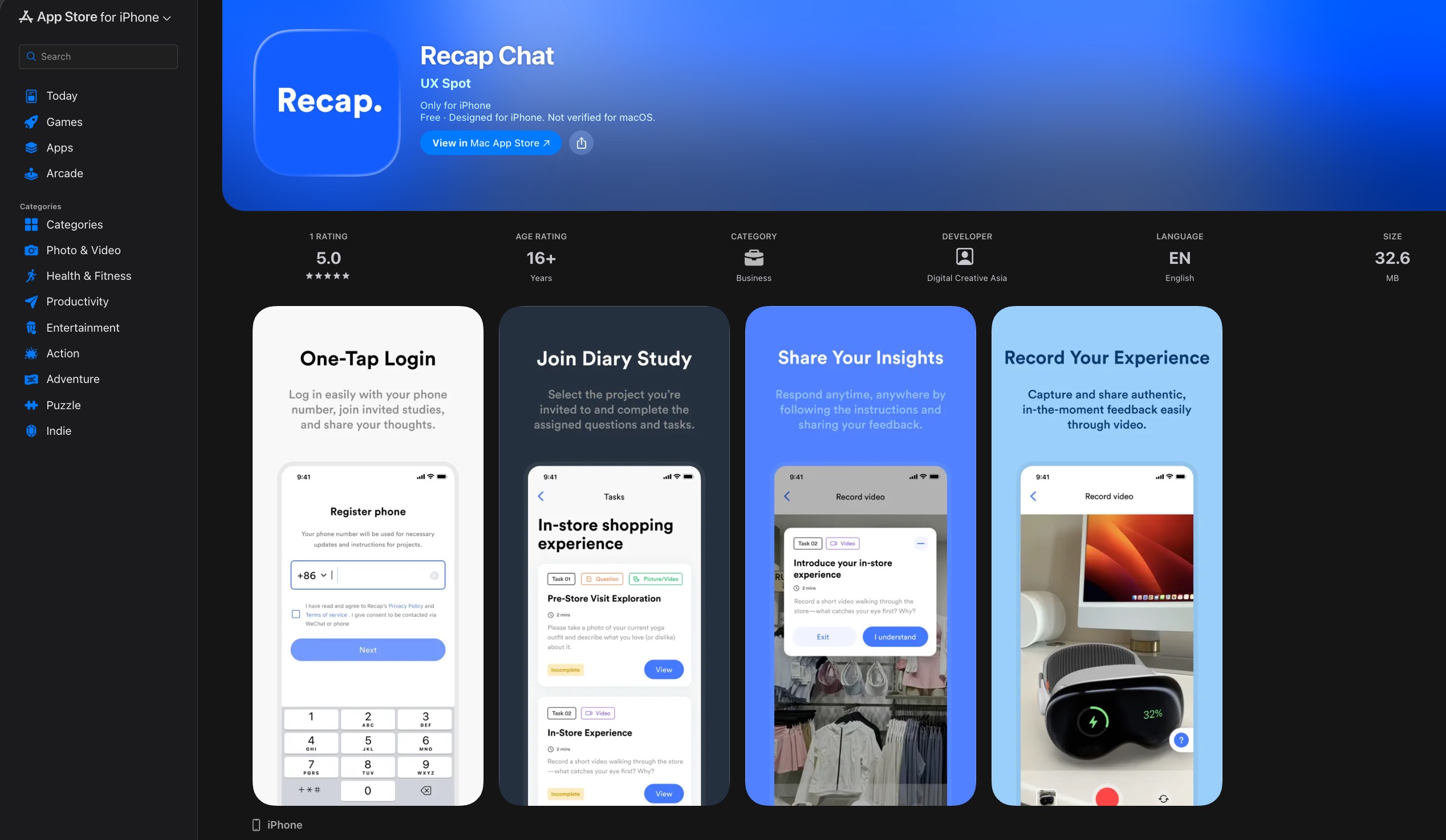
How is Recap Chat deeply integrated into the WeCom ecosystem?
First, Recap leverages the "instant-access" nature of WeChat Mini Programs to lower the participation barrier for potential respondents, enabling lightweight recruitment, survey distribution, and participant screening.
Then, through WeCom, Recap converts recruited "anonymous participants" into "private-domain assets" and a reusable participant database. WeCom also serves as the primary communication channel throughout the entire project lifecycle. Employee identity verification provides enterprise-level credibility, while one-on-one communication establishes strong trust between researchers and participants.
During diary study projects, the Recap mobile app is responsible for data collection tasks such as long-form video uploads, geolocation verification, and system-level push notifications, ensuring high-quality data acquisition.
Meanwhile, within Recap's web-based backend platform, both the project team and brand-side clients can simultaneously review the collected raw data, including text, images, and voice recordings, as well as the structured data processed and analyzed using technologies such as LLMs, NLP, and ASR.
How does AI integrate with the WeCom ecosystem throughout this process?
In traditional diary studies, researchers are often overwhelmed by fragmented follow-up tasks. By connecting its proprietary data pipeline to large language models and deeply integrating with WeCom APIs, Recap enables AI chatbots to take over a substantial portion of these high-frequency interactions. Several representative scenarios include:
- Intelligent Task Supervision: AI monitors project task milestones in the backend. Once a participant misses a diary entry, the chatbot automatically sends a private reminder through WeCom based on predefined schedules, ensuring high task completion rates.
- Real-Time Operational Assistance: When participants encounter difficulties uploading receipts or completing specific tasks in the app, they can directly ask questions through WeCom. The AI combines project-specific knowledge bases with contextual understanding to provide professional, human-like, real-time assistance, escalating to human researchers only when necessary.
- Fully Automated Scheduling Management: For participants selected for in-depth interviews (IDIs), the chatbot directly distributes available interview time slots. Once users complete their booking, the schedule data is automatically synchronized with both the researcher's WeCom calendar and the backend system, creating a fully closed operational loop.
How Should You Choose Your WeCom AI+ Strategy?
As private-domain traffic operations enter a more refined and sophisticated stage, the role of WeCom chatbots has fundamentally evolved. They are no longer simple "auto-reply plugins", but rather the brand's "digital persona" in the online world.
When making strategic decisions, enterprises should comprehensively evaluate factors such as technical complexity, business complexity, data ownership, and user experience in order to select the most appropriate implementation approach. In this fragmented digital era, businesses must provide users with a professional experience that feels "always online, instantly responsive, and deeply personalized."
| Dimension | 1. Native Official Integration | 2. SCRM Authorization Integration | 3. API Custom Integration |
|---|---|---|---|
| Core Logic | Enable basic automated responses | Standardize and scale customer operations | Deeply integrate AI with business workflows |
| Integration Cost | Low; configuration only | Medium; SaaS fees + setup | Medium–high; development & maintenance required |
| AI Conversation Quality | Rule-based, limited context understanding | Good semantic understanding for common scenarios | Advanced reasoning, contextual awareness, and human-like interactions |
| Typical Decision Driver | “Auto-replying FAQs is enough.” | “I need automation to improve conversion.” | “I need intelligent, context-aware customer engagement.” |
Is your brand ready to take the leap? Schedule a call with us today.
Have a project in mind?
Join our newsletter!
Get valuable insights on the latest digital trends, strategies, and developments in China and globally delivered straight to your inbox.