Samuel Jesse recognised for design leadership at IXDC
November 2nd, 2026 · Written by Tom Yu

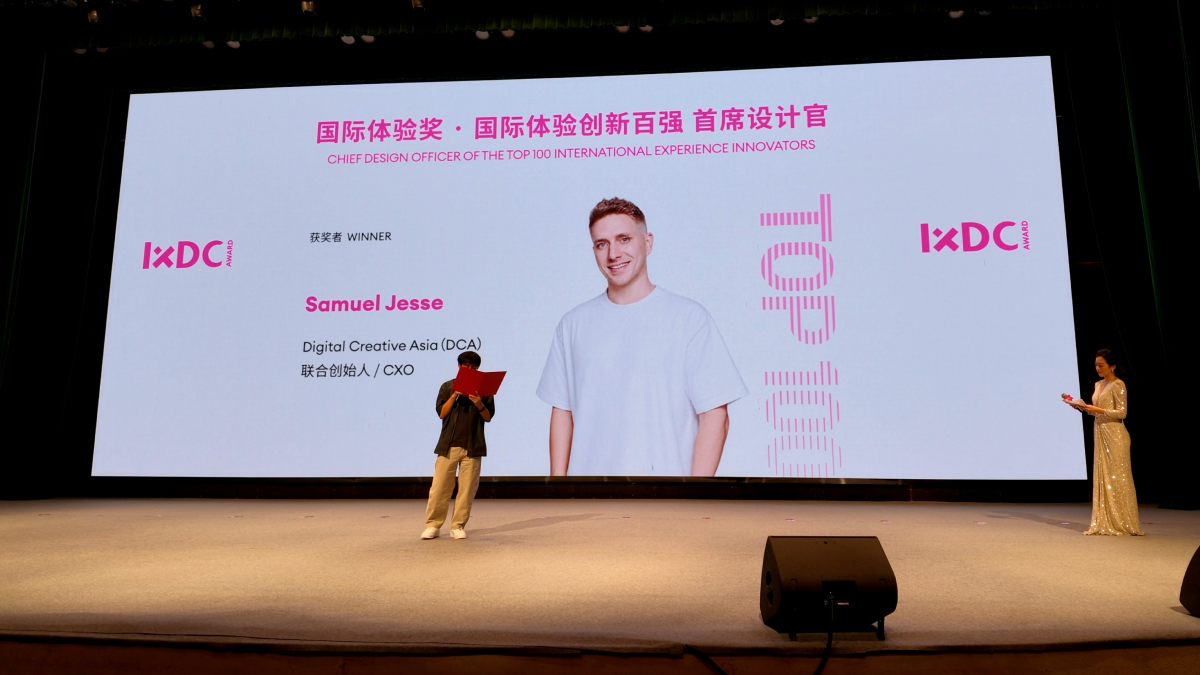
Samuel Jesse, Co-founder and CXO of Digital Creative Asia (DCA), has received the Chief Design Officer award as part of IXDC's 2025 Top 100 International Experience Innovators. The award was presented on 30 October 2026 at IXDC 2026 in Guangzhou, recognising his contribution to design leadership and experience innovation.
For DCA, the recognition celebrates Samuel's work alongside fellow Co-founder Zippora Lau and the wider team, whose shared approach brings research, design and technology together to solve complex digital challenges.
It also comes at an important moment for the design industry, as artificial intelligence changes not only the tools designers use, but the role they play in creating digital products.
Recognising design leadership at IXDC
Held in Guangzhou from 29 October to 1 November, IXDC 2026 brought together designers, technology specialists and business leaders to examine the changing relationship between people, design and intelligent technology.
This year's conference explored human-AI coexistence and the creation of intelligent experiences with human warmth.
Across the keynote discussions, a common question emerged: when AI can generate interfaces, write code and accelerate production, where does the value of design move?
The answer goes beyond making things faster. Designers have a greater opportunity to focus on understanding the problem, evaluating possible solutions and making decisions that improve the experience for the people using a product.
These ideas connect closely with the direction DCA is taking as we rethink how human creativity, research and intelligent technology work together.
From designing interfaces to shaping outcomes
At DCA, design has never been limited to the visible interface. The work starts with understanding what people need, how businesses operate and what technology must do to bring those needs together.
As AI becomes more capable, this foundation becomes even more important.
Generating an interface or building a working prototype may take less time, but deciding what should be built still requires research, context and judgement. A technically functional product is not necessarily one that solves the right problem or makes someone's life easier.
This is where we see the role of designers developing. Less time spent on repetitive production creates more room to examine assumptions, explore alternatives and evaluate the consequences of design decisions.
It also reinforces the importance of evidence. User research and observation help teams move beyond personal preferences and make decisions grounded in how people actually behave and what they need.
For DCA, the opportunity is to use AI to support the creative process while keeping people responsible for the direction, quality and outcomes of the work.
Connecting human creativity with agentic delivery
The shift goes beyond individual design tools.
AI agents are changing how teams can approach the work between an initial idea and a functioning product. Design, code and implementation can become more closely connected, reducing repetitive handovers and helping teams test ideas against working technology earlier.
DCA is exploring how to bring these capabilities into more connected delivery workflows, where human-led research, strategy and creative direction guide work supported by AI agents.
The objective is not to replace the expertise of designers or engineers. It is to allow them to spend more time on decisions that require experience and judgement, while using intelligent tools to support execution.
Making this work also involves changes in how teams collaborate, share knowledge and take responsibility for the results. New technology alone does not create a better process.
That balance between human judgement and technical capability is central to the direction DCA is developing.
A recognition shared with the team
Although the award recognises Samuel individually, he was quick to acknowledge the people behind the work.
Reflecting on the achievement, Samuel said:
"It would not have been possible without my partner Zippora Lau who shares this role with me, and our awesome team at Digital Creative Asia"
Samuel and Zippora share responsibility for DCA's design direction, working with teams across research, strategy, product design and engineering.
That collaboration is an important part of what makes DCA's work possible. Different perspectives help teams challenge assumptions, understand constraints and make better decisions throughout the development of a product.
As AI changes the way digital products are created, this shared expertise will remain essential. The tools may change, and the process may become faster, but the responsibility for understanding people and making thoughtful decisions remains with the team.
Samuel's recognition at IXDC is a moment to celebrate his leadership and the contribution of everyone at DCA.
Congratulations to Samuel, Zippora and the entire team. As we continue to develop new ways of working with AI, our focus remains on bringing human creativity and sophisticated technology together to create digital products that are genuinely useful to people.
Explore our work with AI
Recent cases

Options+ AI Tools
Logi
Desktop App

AI Lesson Review
English First
WeChat mini program
Have a project in mind?
Join our newsletter!
Get valuable insights on the latest digital trends, strategies, and developments in China and globally delivered straight to your inbox.